The textile industry of Turkmenistan — the mills, the yarn and the export trade
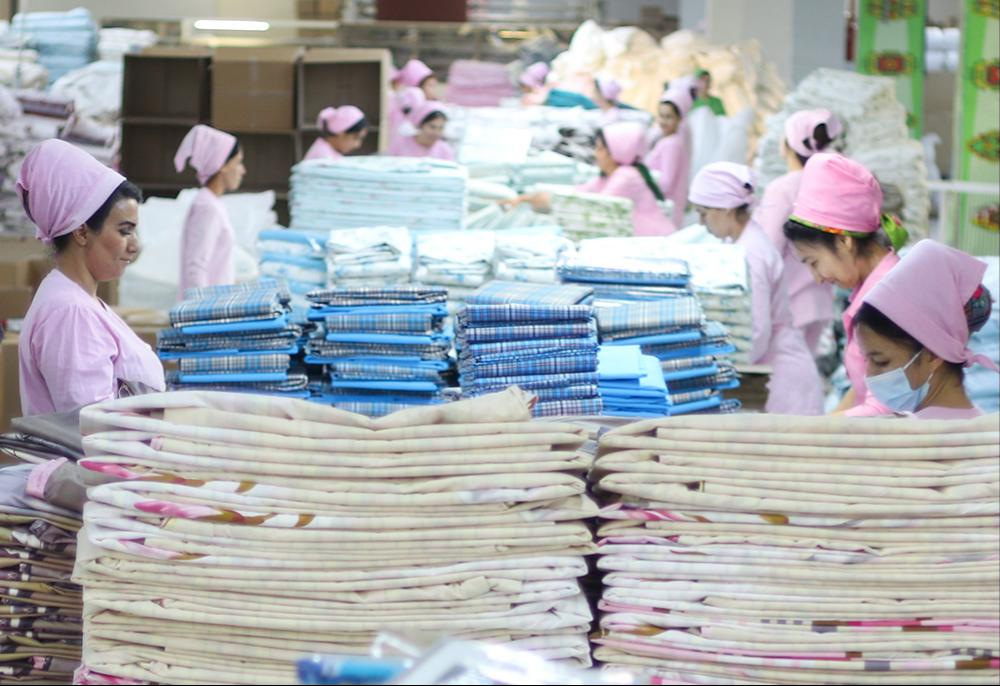
The Ministry of Textile Industry of Turkmenistan runs twenty-eight enterprises, and between them they take Turkmen cotton the whole way — from bale to spun yarn, from greige cloth to dyed and printed fabric, and on to towels, bed linen, shirts and jeans. It is the most vertically integrated industry in the country, and the one whose exports reach the widest range of markets. This is what each mill actually makes, and what a foreign buyer can realistically get.
One ministry, one raw material, twenty-eight enterprises
Unlike the oil and chemical concerns, the textile ministry is not built around a handful of giant plants. It is a chain. Cotton fibre comes in from the ginneries; spinning mills turn it into yarn; weaving and knitting plants turn yarn into cloth; dyeing and finishing houses colour it; and sewing factories turn it into finished goods. Several complexes do all of this on one site.
For a buyer, the practical consequence is that the same ministry can sell you the same cotton at four different stages, and the stage you buy at determines which enterprise you are dealing with. Yarn and greige fabric are the volume export lines; finished goods trade in much smaller quantities.
Everything below is sold through the State Commodity and Raw Materials Exchange — the mills say so themselves. Our guide to how to buy from Turkmenistan through the State Commodity Exchange covers registration and contract approval.
Spinning: where the export volume is
Six dedicated spinning mills produce cotton yarn, and this is the ministry’s largest export by a wide margin.
Dashoguz ring spinning mill
Built under a 2008 resolution with Kotam Enterprises as main contractor. Rated at 14,500 tonnes a year of Ring Nm 16/1, with the range running Nm 10 to Nm 51. Equipment is Marzoli throughout the line — two opening and cleaning lines, twenty carding machines, drawing frames, roving and twenty ring frames — with Savio winders, Loptex foreign-fibre separators and Textechno lab instruments. Annual fibre requirement is about 16,630 tonnes of Grade I, Type 4 cotton.
Turkmenabat cotton spinning factory
Commissioned in October 2009, capacity 17,700 tonnes, producing Nm 10/1, 12/1, 14/1, 17/1, 20/1, 24/1, 27/1 and 34/1. Around 600 employees, German, Italian and Turkish equipment.
Balkandokma
Running since 2004 in Gyzylarbat, with 630 specialists and Marzoli, Vouk and Savio machinery. Its laboratories use Uster, Zweigle and Aqua Boy instruments, and only fibre that passes length and moisture testing enters the line — a detail worth knowing if you are specifying to a count.
Turkmengala, Tagtabazar and Halach
Turkmengala dates from a 1992 contract with Engin Grup and came on line in 1994; it spins by the pneumomechanical (open-end) method, rated at 10,500 tonnes a year at Nm 14, and can run Nm 10 to Nm 40. Tagtabazar, commissioned in 1997, is rated at 4,500 tonnes and makes Nm 20/1, 27/1 and 34/1 — and states plainly that its exports go to Türkiye, the UAE, Pakistan, India and China under contracts signed at exchange auctions. Halach, a joint venture with Norsel International, opened at partial capacity in 2002 and in full in 2005.
Between them these mills supply ring carded, ring combed, open-end and dyed yarns.
The integrated complexes
Ashgabat Textile Complex
Opened in February 2007 on 37.5 hectares and described by the ministry as the largest complex in Central Asia. Annual output is 5,190 tonnes of terry fabric, 55 million square metres of cotton fabric and 19.825 million textile items. Machinery is Karl Mayer, Osthoff, Küsters and Brückner from Germany, Savio, Simet and Mario Crosta from Italy, Tsudakoma and Juki from Japan. It carries ISO 9001, ISO 14001 and OHSAS 18001, and enterprises in the sector also work to OEKO-TEX and WRAP. Its stated customers are in Russia, Belarus, the United States, Türkiye and Europe. We have a separate profile of the complex.
Ruhabat Textile Complex
The greige fabric specialist, running since 2012. Weaving holds 144 Karl Mayer and Picanol machines producing 20.03 million square metres of greige a year — gabardine, armour, ranforce, flannel, poplin, cretonne, satin and panama in various weights. Dyeing and printing, on Monforts, Mario Crosta, Benninger and Reggiani equipment, turns out 40 million square metres of finished cloth a year. Spinning adds 13,041 tonnes on Marzoli and Savio lines, open-end from Nm 10/1 to Nm 51/1 and ring from Nm 20/1 to Nm 51/1.
Kaka and Babadaýhan
Both commissioned in 2021, and both built as four-factory complexes — spinning, weaving, dyeing and finishing, and garments. Kaka spins 3,650 tonnes a year, weaves 12 million square metres of greige (cretonne, ranforce, gabardine, dyed-fibre and upholstery cloth), finishes 10 million square metres, and sews 1.2 million finished pieces — men’s shirts, trousers, jackets, coats and jeans.
Bayramaly
The towel and bathrobe plant, built in two phases completed in 2002 and 2005 on 16 hectares. It spins Nm 14/1 to Nm 34/1 on 32 Marzoli, Schlafhorst and Trützschler machines, weaves raw terry cloth on 59 Italian and German looms, dyes on 16 machines, and sews on 66. Output is towels from 30×30 up to 180×210 cm, bathrobes for men, women and children, and kitchen sets to order.
Gypjak and Turkmenbashy (Nusay)
The Gypjak complex, opened in 1997, runs four factories — yarn at 4,250 tonnes, knitting at about 4,050 tonnes, dyeing at 3,850 tonnes and sewing at 15 million units. The Turkmenbashy Textile Complex covers 230,000 square metres with spinning, weaving, knitting, dyeing and clothing factories under one management, working three shifts, and exports to the United States, Europe, Australia and Russia.
Denim
The Türkmenbaşy Jeans Complex, a Turkmen–Turkish venture with GAP Türkmen operating since 1996, is the country’s denim producer — denim fabric and finished jeans, sold under the Bedew label as men’s jeans. We have a separate profile of the complex. Kaka’s garment factory also makes jeans, so denim is not a single-source product.
Beyond cotton cloth
Several enterprises sit outside the main cotton chain and are easy to miss.
The Ashgabat Panbarhat factory, opened in 2008, weaves velvet from 100% silk with customer-specified colours and patterns. The S.A. Niyazov combine in Ashgabat — running since 1929, the oldest enterprise in the ministry — produces textiles, about 2,500 thousand pairs of socks a year, and sintepon wadding. The Ashgabat medical and cosmetic cotton factory, opened in 2009, processes up to 4,800 tonnes of refined fibre waste into 4,200 tonnes of medical cotton and 12.4 million cosmetic cotton items a year. Türkmen-Galkan at Anau, a Turkmen–Turkish venture from 1997, makes footwear for uniformed services and civilian use, with hides from the Mary and Gökdepe tanneries.
Sewing capacity is spread across Bahar in Ashgabat (running since 1960, ready-made clothing and knitwear), Çeper in Dashoguz (1983, modernised in 2013, schoolwear and workwear), Ýeňiş in Mary (men’s and children’s shirts in pure cotton and 80/20 cotton-polyester), and the Ahal association. There is even a factory at Turkmengala making the paper tubes the yarn is wound onto, at 105,000 a day.
What actually reaches the export market
The textile ministry’s lots on the State Commodity Exchange over the last four years tell a different story from the hydrocarbon concerns, and it is a more encouraging one.
The destinations are genuinely diverse. Where Turkmen fuel and fertilizer go overwhelmingly to Afghanistan and the UAE, textile lots go first to Türkiye by a wide margin, then the UAE, Kyrgyzstan and Azerbaijan, with China, India, Pakistan, Kazakhstan, Georgia and even Ireland and the United Kingdom appearing in the record. This is the one Turkmen export sector with an established route into European buying.
Cotton yarn is the volume line. It accounts for the large majority of export lots, in tonnages that run to tens of thousands of tonnes, and the counts that actually trade are concentrated: Nm 27/1 and Nm 34/1 dominate, followed by Nm 20/1, 17/1 and 14/1. If you are specifying something outside that band, expect longer waits and fewer lots.
Fabric follows, and it is almost entirely Türkiye. Greige and finished cloth trade in linear metres rather than by weight, and the recorded destination is Türkiye in nearly every case — which reflects the Turkish garment industry’s appetite for Turkmen cloth rather than any restriction on who may buy.
Finished goods trade thinly. Towels and bathrobes, bed linen, knitwear and garments all appear, but in tens of lots rather than hundreds, and a good share of what is listed is sold domestically. Bed linen is the exception worth noting, with China appearing as the leading recorded buyer.
One thing the record does not show
Hand-woven Turkmen carpets trade heavily on the exchange and are often assumed to belong to this ministry. They do not — carpet production sits under a separate organisation, and almost all of those lots are domestic. If carpets are what you are after, that is a different conversation and we can point you at it.
Sourcing from the textile sector
We cover the chain at every stage — cotton yarn, woven and knitted fabric, home textiles and apparel and footwear.
Tell us the count or the construction, the quantity and the destination, and we will come back with which mill it comes from, whether that specification has actually been trading in export lots, what the realistic lead time looks like, and which certifications the producing plant holds. Where you are asking for something the mills make but rarely export, we will say so rather than let you plan around it.
We can buy on your behalf so you never deal with the exchange directly, or register you in your own name and walk your file through financial monitoring, the broker appointment and contract registration — the better route if you intend to buy regularly.