Türkmenbaşy Jeans Complex — Bedew denim from Turkmenistan
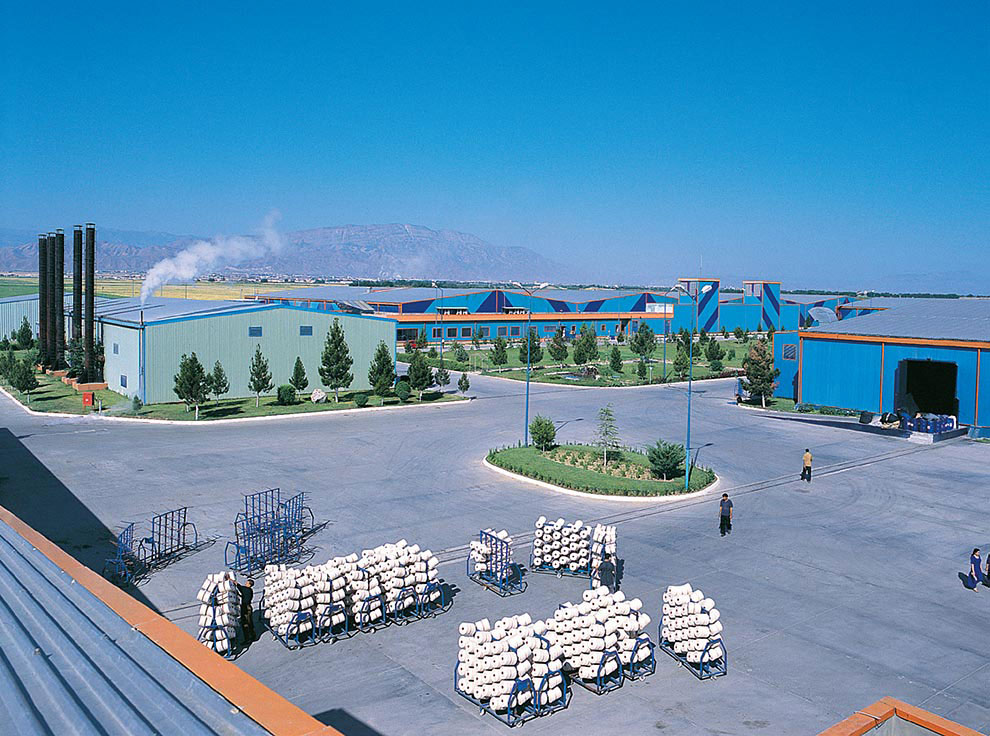
The Türkmenbaşy Jeans Complex is where Turkmen cotton becomes denim. It spins its own yarn, dyes it indigo, weaves the cloth and sews the finished garments on one 21.5-hectare site, under the Bedew label and to the specifications of foreign brands. It is the country’s denim producer, and both its fabric and its jeans reach export buyers — but by different routes, which is the thing worth understanding before you enquire.
Built in stages
The complex came together over several years: the dyeing workshop was commissioned in 1995, the spinning and sewing factories in 1997, and the enterprise operates as a Turkmen–Turkish venture with GAP Türkmen. It covers 21.5 hectares in the Ruhabat district outside Ashgabat and employs around three thousand people.
Annual output is about 9,000 tonnes of yarn and 1.875 million pairs of jeans.
From cotton to indigo
Production starts where all Turkmen textiles start — with cotton fibre, opened, blended, cleaned, carded, drawn, spun and pressed into yarn. Batches are checked in the complex’s own laboratory before they go anywhere near colour.
The dyeing workshop runs three shifts with about 75 specialists and dyes roughly 12,000 metres of yarn blue per shift, with dye dosing and delivery under computer control. Indigo depth and consistency are the whole game in denim, and a computer-controlled dye house is the reason this plant can hold a shade across a large order.
Weaving and sewing
Dyed yarn goes to weaving and then to the sewing factory, which runs German, Swiss and Japanese machinery. More than 900 people work there across two shifts, making trousers, shirts, jackets and shorts.
The complex also runs a laser finishing workshop, where patterns, gradients and emblems are burned into the denim in about 90 seconds a piece. For a buyer that matters more than it sounds: laser finishing replaces the sandblasting and heavy washing that carry both an environmental and a labour-safety cost, and it makes short-run custom finishes practical.
Bedew, and manufacturing for other brands
The complex sells finished denim under its own Bedew label, which is the name most people search for. Bedew garments have been exported to Russia, Ukraine, Türkiye, the United States, Kazakhstan and other markets in Europe and Asia. If you are looking for the retail product rather than a supply contract, our catalogue page for Turkmen men’s jeans is the place to start.
It also manufactures to other companies’ specifications, having fulfilled orders for Collin’s, Zolla and Modis. That is the more useful fact for a sourcing buyer: this is a plant with a working history of private-label production, not one that only makes its own brand.
It holds ISO 9001, ISO 14001 and OHSAS 18001, and applies the WRAP standard for responsible production — the certification set most European and American apparel buyers will ask for first.
What actually trades: fabric and garments take different routes
Reading the denim record on the State Commodity Exchange over the last four years turns up a distinction that is easy to miss.
Denim fabric is sold by the ministry’s mills, in large volumes — well over a hundred export lots between fabric and garments, with the fabric side running to around thirteen million linear metres. It goes overwhelmingly to Türkiye, with the UAE, Azerbaijan and occasionally the United Kingdom also appearing.
The weights that actually trade are worth knowing before you specify. 12 oz is by far the most common, followed by 15 oz, with 8, 10, 11, 13 and 14 oz cloth appearing in smaller numbers. If your programme needs something outside 8–15 oz, expect to wait.
Finished denim garments behave differently. Roughly a million and a half pieces have been exported, but a large share of those lots are listed by private producers rather than the state complex, and their main destination is Kyrgyzstan, then Türkiye and the UAE. This matters because private producers are not obliged to sell through the exchange — they can contract with you directly. For jeans specifically, that can be the faster route.
Our guide to how to buy from Turkmenistan explains which producers are obliged to use the exchange and which are not.
Where this sits in the industry
The Türkmenbaşy complex is not the only source of Turkmen denim — the Kaka textile complex, commissioned in 2021, also sews jeans as part of its garment factory. And the Ashgabat Textile Complex covers the home-textile side of the same cotton chain. For the full picture of the mills and what each one makes, see our guide to the textile industry of Turkmenistan.
Sourcing denim from Turkmenistan
We work with both sides of this market — denim fabric by the metre and finished apparel, from the state complex and from private producers.
Tell us the weight and construction, the quantity and the destination, and we will come back with who makes it, whether that weight has been trading in export lots, whether a private producer can supply you directly, and what the laser-finishing and private-label options look like. If you are a brand looking for a manufacturing partner rather than a shipment, say so — that is a different conversation and this plant has done it before.