Ashgabat Textile Complex — Aşgabat Dokma Toplumy
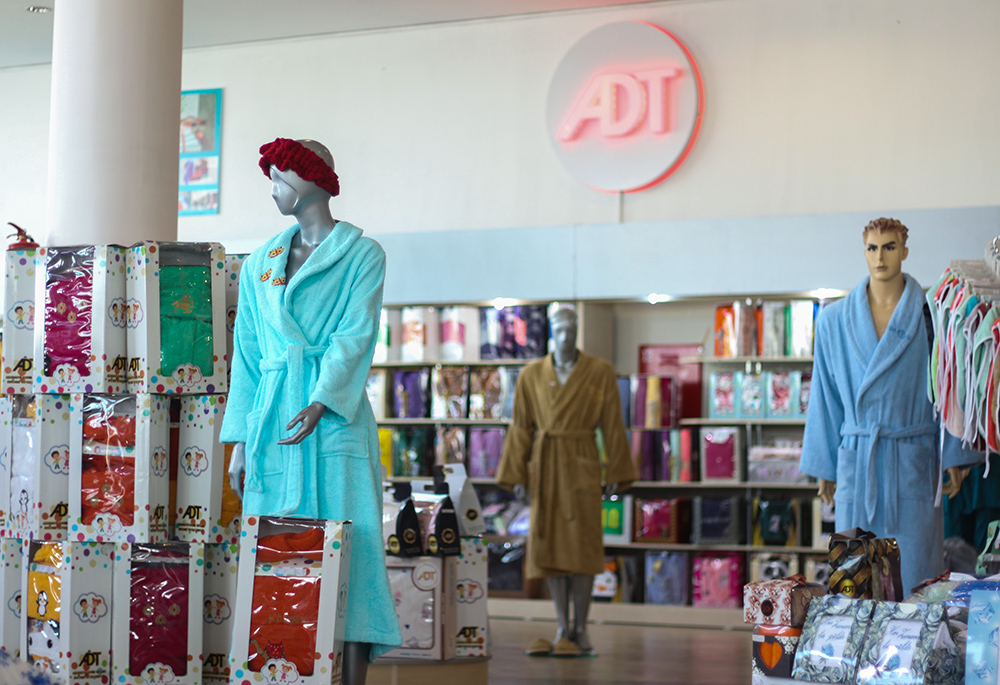
The Ashgabat Textile Complex — Aşgabat Dokma Toplumy, or ADT — is the largest textile plant in Turkmenistan and, by processing capacity, one of the largest in the CIS. It spins, weaves, dyes and sews on a single 37-hectare site, employs some 2,800 people, and turns Turkmen cotton into towels, bathrobes, bed linen and fabric that reaches Europe, Russia, Türkiye and the United States. This is what it runs and what it can make for you.
Two stages, one site
The complex was built in two phases. The first was commissioned in February 2007 at 597 Bitaraplyk Avenue in Ashgabat; the second followed in October 2013, with its equipment selected at ITMA 2011 in Barcelona. The site covers 37 hectares and holds four production stages — spinning, weaving, dyeing and sewing — in sequence.
Annual processing capacity is 13,100 tonnes of cotton yarn and 22.5 million square metres of raw cotton fabric. Around 2,800 people work there, most of them women, with uniform colours varying by workshop.
Spinning
The spinning facility runs automated machinery from Tsudakoma of Japan, Brückner and Karl Mayer of Germany, Stäubli of Switzerland, Pentek of Italy and Dilmenler of Türkiye, with Tsudakoma TWS-E 100/2400 equipment on the cotton line. Yarn for fabric is wound by two methods.
After warping, the yarn is sized in chemical solutions to give it the strength the weaving process demands, then dyed to the required colour where dyed-yarn fabric is being made. Karl Mayer equipment handles that route, and fabrics woven from dyed yarn account for about 20% of all terry fabric the complex produces. The same mills across the ministry supply cotton yarn as a traded product in its own right.
Weaving
Across both stages the weaving department is capable of about 5,000 tonnes of raw pile fabric and 55.8 million square metres of raw cotton fabric a year, on 260 looms. Thirty-eight of those weave by the jacquard method and 222 by the reinforcement method.
The jacquard machines are the ones worth asking about: they place three-dimensional patterns on the fabric surface, and the complex uses them mainly for luxury cloth destined for hotels. If you are sourcing for hospitality rather than retail, that is the capability to specify.
Dyeing and printing
The dyeing centre can colour 4,900 tonnes of terry fabric and 70.6 million square metres of cotton fabric a year, and can apply patterns to the cloth surface. It works with satin, jacquard-satin, ranforce, cretonne and flannel — the same constructions the ministry’s other mills weave in greige, which means ADT can take cloth to a finished state that some of the spinning-only plants cannot.
Sewing and finishing
The sewing facility runs Juki machines for straight seams and overlocking, with dedicated machines for bedding sets and terry napkins. It produces 4,680 tonnes of terry products and 19.8 million finished garments a year. Finished goods move to a packing facility that handles both ordinary and gift packaging — relevant if you are buying for retail rather than contract supply.
What ADT makes
The cotton yarn that enters the chain leaves it as napkins, terry towels for home and bath, terry bathrobes for adults and children, bed linen sets, cotton bedspreads, kitchen textiles and soft children’s toys. Towels are made both plain and in terry jacquard, and designs run from floral and natural through geometric to cartoon prints. The full range sits in our home textiles catalogue.
Three things distinguish ADT from the other mills. It launched the first organic textile products made in Turkmenistan. It is the first soft-toy manufacturer in the country. And it sells under its own ADT trademark as well as the newer Vada and Goza labels — while also producing for established foreign brands, including the Turkish house TAÇ. A plant that already manufactures to another brand’s specification is one that understands private-label work, which is not true of every mill in the sector.
Certification and markets
The complex holds ISO 9001 for quality management, ISO 14001 for environmental management and OHSAS 18001 for occupational health and safety, and enterprises across the sector also work to OEKO-TEX and WRAP. Its stated customer markets are Russia, Belarus, the United States, Türkiye and European countries.
For the wider picture — the spinning mills that supply the yarn, the other complexes, and which specifications actually trade for export — see our guide to the textile industry of Turkmenistan.
Sourcing from the Ashgabat Textile Complex
ADT is a state enterprise, which means its export contracts go through the State Commodity and Raw Materials Exchange rather than being agreed at the factory gate. Our guide to how to buy from Turkmenistan through the exchange explains what that involves.
Tell us the product, the construction or GSM, the quantity and the destination, and we will come back with whether ADT or one of the other mills is the right producer, whether that specification has been trading in export lots, what packing options exist, and what a realistic lead time looks like. For hospitality buyers we can ask specifically about the jacquard capability; for retail programmes, about private-label and gift packing.
We can buy on your behalf so you never deal with the exchange directly, or register you in your own name and take your file through financial monitoring, the broker appointment and contract registration.