How to buy from Turkmenistan: the State Commodity Exchange explained
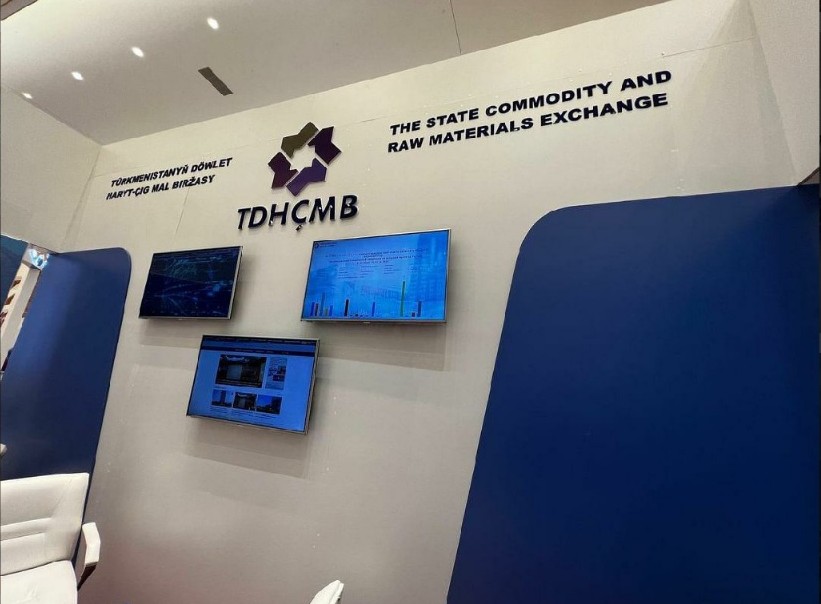
Most of what Turkmenistan exports is made by state-owned enterprises, and a state enterprise cannot simply sell to you. It is required to sell through the State Commodity and Raw Materials Exchange in Ashgabat. For a foreign buyer this is usually where interest stalls — not because the door is closed, but because nobody explains where it is. This guide sets out how the exchange works, what a non-resident buyer actually has to do, and where the real delays sit.
Why the exchange sits in the middle
The exchange operates under the Law of Turkmenistan “On Commodity Exchanges”, and it fills two distinct roles. Understanding which one applies to your purchase is the first thing to get straight, because it determines how much procedure you are facing.
In Turkmen it is Türkmenistanyň Döwlet Haryt-Çig Mal Biržasy, abbreviated TDHÇMB — worth recognising, because that is the form you will see on stamps, invoices and correspondence rather than any English rendering.
For state-owned producers: it is the sales channel
The large industrial producers — the refineries, the gas-chemical complexes, the state textile mills, the chemical concerns — are obliged to route their sales through the exchange. Their output is listed as lots, and buyers bid in open session. There is no route around this. A factory director cannot sign a private export contract with you, however willing he is, because selling through the exchange is not his choice to make.
This is why so much of the country’s exportable output appears on one platform, and why the exchange’s records are a fair picture of what is actually leaving the country.
For private producers: it is the registration authority
Turkmenistan’s private manufacturers — a growing group, particularly in textiles, food processing, packaging and building materials — are not bound to sell through the floor. You can negotiate with them directly.
But you still meet the exchange at the end, because it registers foreign trade contracts. A privately negotiated deal has to be brought in and registered before it is valid for customs and currency purposes. You can agree everything with an owner over a good lunch and still have no contract until the paperwork has been through the building on Archabil şaýoly.
So the practical question at the outset is simply: is this producer state-owned or private? State-owned means a full exchange purchase, with trading access and a bid. Private means a direct negotiation followed by registration — considerably lighter, and the reason a first-time buyer is often better off starting with a private supplier.
Either way, you are entitled to be there
The stated principles of exchange trading are transparency and publicity, free price formation, voluntary conclusion of transactions, and equality of participation. That last point matters more than it sounds: foreign legal entities and individuals may act as buyer or seller on the same footing as Turkmen ones. The barrier is procedural, not legal.
What actually trades there
The listing mix reflects what the country produces. On the commodity side that means refined petroleum products — including bitumen, coke and waxes, LPG and polymers — plus chemicals and fertilisers.
On the manufactured side, the largest recurring volumes are textile: cotton yarn, grey and finished fabric, home textiles and made-up garments. Alongside these sit agricultural raw materials such as licorice root and its extracts, and specialised chemical output such as iodine and its salts.
Cotton fibre, yarn and fabric quotations are published openly on the exchange’s own site, which makes the textile chain the easiest sector for a newcomer to read.
The two routes onto the floor
If your producer is state-owned, you are buying on the floor, and you need trading access to do it. There are two ways to get it: hold a brokerage place of your own, or contract one of the exchange’s brokers to act for you. This is the fork that determines everything else about your cost and timeline.
Route one — buy a brokerage place
A brokerage place is a seat: an annual licence to trade in your own name, held by a nominated representative who becomes your registered broker. Non-residents can hold one, and the annual cost is modest. What is not modest is the deposit.
- Oil and gas commodities, and goods of the Türkmenhimiýa state chemical concern — $10,000 a year, against a refundable deposit of $150,000
- All other sectors — $5,000 a year, against a refundable deposit of $10,000
Read that banding carefully before you budget. It is drawn by product, not by company size, so a buyer of fertilisers or industrial chemicals sits in the upper band alongside the oil traders, while a textile or foodstuffs buyer sits in the lower one at a fifteenth of the deposit.
To register a seat you complete financial monitoring registration, then submit a document package: a letter of appeal to the Chairman of the exchange requesting registration and purchase of a place; a completed “Commitment” form, sealed and signed by the head of the company; a power of attorney for the representative who will act as broker; passport copies for both that representative and the company head; a 3×4 photograph of the broker; and copies of the constituent documents — charter and registration certificate. You then take invoices from the Mutual Settlements department and pay.
A seat lapses if the annual fee is not paid on time, on application to close it, on a decision of the exchange’s Arbitration Commission, or if the legal entity is wound up.
Route two — engage a broker
Anyone who has not bought a seat can conclude a service contract with an existing exchange broker, who transacts on their behalf. The broker charges $150 on contracts up to 525,000 manats, and 0.1% of value above that.
For most foreign buyers this is the correct route, at least to begin with. A seat only makes sense if you intend to trade continuously, in your own name, at volume — and to leave the deposit sitting there while you do it. A buyer placing two or three contracts a year will find the brokerage commission is a rounding error next to the capital a seat immobilises.
That said, the calculation flips once you are trading regularly. If you are moving several wagons a month, trading in your own name gives you direct visibility of the session, control of your own bidding, and a standing presence that producers recognise. Buyers who intend to build a long-term position in Turkmenistan generally end up with their own place. The question is when, not whether.
Before anything else: financial monitoring
Whichever route you take, you begin at the same place. The exchange runs a Financial Monitoring department implementing anti-money-laundering and counter-terrorist-financing rules. Every client is assessed, assigned a risk level and entered into the system before being allowed to transact.
Registration here can now be started online through the exchange’s customer portal, where you can enter company data, upload documents, download the blank forms and questionnaires, and correspond with the administrators if your package is incomplete. The forms differ for residents and non-residents, and the exchange publishes both lists.
Budget real time for this stage. It is the step where foreign applicants most often stall, usually over notarisation, translation, or a constituent document that does not have an obvious Turkmen equivalent.
How an exchange purchase actually proceeds
This is the full sequence for buying from a state producer. A direct purchase from a private producer skips steps two and three entirely and joins at contract drafting.
1. Identify the lot and the seller
Goods are listed by the producing enterprise, which must itself obtain permission to place them: a request letter, a formal application for sale, a product specification drawn up to the exchange’s requirements, proof of the right to trade, and documents establishing the origin of the goods. What reaches the floor has already been through that filter, which is why the specification you see is generally reliable.
2. Get access to trading
Either your own broker on your own seat, or a signed service contract with an exchange broker. One-off participation without buying and selling rights is also possible, which is a cheap way to observe a session before committing.
3. The trading session
Deals are struck in open session. Price forms freely within the session rather than being administratively set, and the resulting quotations are published afterwards. Your broker bids on your instruction — so the quality of your written instruction, particularly on grade, tolerance and delivery basis, is what determines whether you get what you meant to buy.
4. Contract drafting
Once a transaction is concluded, the contract is drawn up. The exchange itself provides drafting and printing as a chargeable service, priced per page, with a separate charge for each subsequent annex or additional agreement. Getting the specification and the delivery terms right at this stage is far cheaper than amending later.
5. Registration
The contract then goes through the exchange’s internal route, and this is the stage that governs your timeline. Documents are accepted between 9:00 and 17:00, and pass in sequence through the Price Analysis and Market Research department, then Law and Personnel, then the Registration department, then Mutual Settlements, and finally to management for signature.
Note what the first of those does. Price analysis means your contract price is checked against world market benchmarks. A price that looks unjustifiably low will not simply be waved through — which is worth knowing before you negotiate a keen deal and assume it will survive scrutiny.
6. Payment and shipment
With the contract registered, payment and shipment follow the agreed terms. Most export business is done on hard-currency terms; the manat is not freely convertible and payments route through the state banking system, so build the banking chain into your planning rather than treating it as an afterthought. Most listings are quoted for collection at the works or the nearest rail terminal, leaving onward carriage to the buyer.
What it costs to participate
Separate from the price of the goods, the exchange publishes its tariff schedule openly, with distinct rates for residents and non-residents. The non-resident schedule is set in US dollars.
- Customer registration with the financial control department — $300
- One-time participation in a session, without buying or selling rights — $100
- Brokerage place, oil and gas and Türkmenhimiýa goods — $10,000 a year, deposit $150,000
- Brokerage place, all other sectors — $5,000 a year, deposit $10,000
- Brokerage commission — $150 up to 525,000 manats of contract value, 0.1% above it
- Contract drafting and printing — $30 per page
- Each additional agreement or annex — $150
- Price conclusions and world-market price analysis — $30 per item
Set against a full wagon or container load, none of these are significant. The deposit on a seat is the exception, and it is the reason most first-time buyers work through a broker.
The $100 one-time participation is worth noting on its own. It buys you attendance at a session without trading rights — the cheapest possible way to watch how the floor actually operates before committing to anything. If you are seriously evaluating Turkmenistan as a source, it is money well spent.
Where deals actually go wrong
In our experience the failures are rarely dramatic. They cluster in four places.
An incomplete financial monitoring file. A missing apostille or an untranslated charter can cost weeks before you have even seen a lot.
A loose specification. “Bitumen” is not a specification. Grade, test method, packing and tolerance all need to be in the contract, because the contract is what the producer will ship against.
Underestimating logistics. Turkmenistan is landlocked. Whether goods leave across the Caspian, south through Iran, or overland to the north and east changes cost and transit time substantially, and it is your problem under most delivery terms.
Treating registration as a formality. It is a review, with a price-justification step inside it. Contracts do get sent back — including privately negotiated ones, which is where buyers who never expected to deal with the exchange at all are most often caught out.
How we can help
The exchange is a genuine, rules-based institution, and the procedure above is followed rather than improvised. But it is conducted in Turkmen, on the ground, and in a market where knowing which producer actually has availability this month is worth more than any published listing. Depending on how far you want to go yourself, there are two ways we work.
We buy on your behalf
You never touch the exchange. Tell us the product, grade, volume, packing and destination; we identify the producer with real availability, handle brokerage, contracting and registration, and deliver a contracted, documented shipment. This is the right starting point for a first purchase, and for buyers whose volumes do not justify a permanent presence.
Part of that is knowing which producers are state-owned and which are private — because for the same product the two routes look completely different, and the private route is often faster than buyers expect.
We register you in your own name
If you want to be on the exchange yourself — to attend sessions, to hold your own brokerage place, to trade under your own company — we will get you registered. That means assembling and translating the financial monitoring package, preparing the letter of appeal and the Commitment form, arranging the power of attorney for your nominated broker, taking the file through the Financial Monitoring and Mutual Settlements departments, and setting up your customer portal account.
We can also arrange the one-time participation that lets you sit in on a session before you commit to a seat, and handle the practical side of a visit to Ashgabat around it. Buyers who intend to be in Turkmenistan for the long term are usually better served owning the relationship directly, and we would rather set you up properly than keep you dependent on us.
Tell us which of the two fits, and we will come back with the steps, the timeline and what it will cost.