State Concern Turkmenhimiya — the chemical industry of Turkmenistan
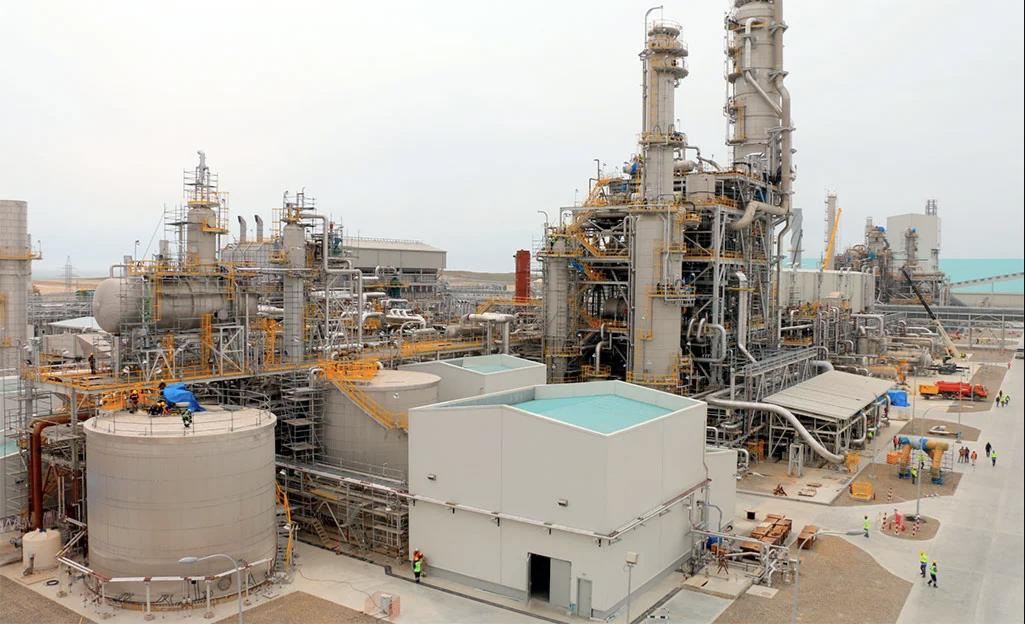
State Concern “Turkmenhimiya” is the backbone of the chemical industry of Turkmenistan. Eleven plants sit under it — three urea complexes, the country’s only phosphate works, a potash mine, a gas-to-polymer plant, the salt combine on the Caspian shore, an iodine factory drawing on brines that are among the richest in the world, and the plant that turns natural gas into petrol. Between them they account for almost everything chemical that leaves the country. This is what each one makes, and what actually reaches export buyers.
What the concern is, and why it matters to a buyer
Turkmenhimiya is not a company in the sense a foreign buyer is used to. It is a state concern — a holding structure that owns and directs the chemical plants on behalf of the state. The plants themselves are legal entities, but the commercial decisions, the export programme and the sales channel run through the concern.
That last point is the one that changes how you buy. Because the producers are state-owned, they are required to sell through the State Commodity and Raw Materials Exchange in Ashgabat rather than contracting with you directly. If you have not dealt with that process before, our guide to how to buy from Turkmenistan through the State Commodity Exchange explains what registration involves and where the delays are. Everything below is bought that way.
Nitrogen: three urea plants built in fifteen years
Turkmenistan has cheap natural gas and no shortage of it, and urea is the most direct way to turn gas into an exportable product. Three plants were commissioned between 2005 and the late 2010s, each with a different set of Western licensors, and together they make granular urea 46% the single largest chemical export the country has.
Tejenkarbamid
The first of them. Built by GAP İnşaat of Türkiye following a presidential decision of May 2001 and installed at Tejen in 2005, with a designed capacity of 350,000 tonnes a year. The licensor set is a good illustration of how these plants are put together: Krupp Uhde of Germany for the ammonia, Stamicarbon of the Netherlands for the urea, UOP of the United States for carbon-dioxide distillation and HydroFertilizer of Norway for granulation. Equipment came from Mitsubishi, MAN Turbo and York. The whole cycle is automated from a central control room. Plant profile.
Marykarbamid
Contracted in December 2009 with a consortium of Kawasaki Plant Systems and Sojitz Corporation of Japan, built by Rönesans of Türkiye, and commissioned in October 2014 at Mary. Ammonia technology from Kellogg Brown & Root, urea from Stamicarbon, granulation from Uhde Fertilizers Technologies. Natural gas is the feedstock. Of the three urea plants, Marykarbamid is the one named most often in exchange listings — buyers see it specified as the loading point. Plant profile.
Garabogaz ammonia and urea plant
The newest and the largest, built on the Caspian at Garabogaz under a 2014 turnkey contract with Mitsubishi Corporation and GAP İnşaat. Haldor Topsøe licensed the ammonia, Saipem the urea and Uhde Fertilizers Technologies the granulation, with process control built on Yokogawa, Honeywell and Siemens systems. Its output was designated for export from the outset, which is the practical difference between this plant and the older two — it was built to earn foreign currency rather than to supply Turkmen agriculture. Plant profile.
Maryazot
The oldest nitrogen site, commissioned in 1984 and the first in the country to make nitrogen fertilizer. Its main product is ammonium nitrate, supported by two ammonia workshops rated at 600 tonnes a day and a nitric acid workshop rated at 1,080 tonnes a day of weak acid. A coagulant line — ferric sulfate — was added in 2005 and a small soda ash line in 2006. The plant also makes liquid nitrogen, liquid oxygen and the polypropylene bags the fertilizer ships in. Plant profile.
Phosphate: one plant, and a longer product list than its name suggests
The Turkmenabat chemical plant named after S.A. Niyazov is the only phosphate fertilizer producer in Turkmenistan, and it has been running since 1960, when it was built to supply Central Asia with mineral fertilizer. Its history is a series of additions: a sulfuric acid workshop in 1960, simple superphosphate at 247,000 tonnes a year from 1961, ammoniated superphosphate at 350,000 tonnes a year from 1967, an oxygen unit in 1966, a polyethylene goods workshop in 1971, ammophos and extraction phosphoric acid in 1980.
The decisive change came in 1997. Phosphate rock had to be imported, so the plant’s engineers developed a route to ammonium superphosphate that reduced the dependency — and that product is still the plant’s main output today. A newer granular version carries sulfur alongside the phosphate and nitrogen. A second sulfuric acid workshop rated at 500,000 tonnes a year came online in 2016, which is why technical sulfuric acid now appears as a traded product in its own right rather than only as an intermediate.
The rest of the plant’s range is worth knowing about because it rarely gets described in English: fertilizer ameliorant, made by processing the plant’s own phosphogypsum and used to bring saline-alkali soils back into production; oxyhumate; aluminium sulphate as a water-treatment coagulant; industrial and medical oxygen; and polymer goods including non-pressure polyethylene pipe and film.
Potash: Garlyk
The Garlyk potash mining and processing complex was the first potash producer in the country. Ordered by decree in January 2010, built by Belgorkhimprom of Belarus and commissioned in March 2017, it is rated at 1.4 million tonnes a year. Ore is mined conventionally and enriched at an ore-dressing plant split into fine-grained and granular sections, so potassium chloride is available in both fractions — worth checking before you specify, because the two suit different blending operations.
Salt, iodine and the Caspian brines
Three of the concern’s plants exist because of what is dissolved in the water on and under the Caspian shore.
Guvlyduz
A salt works more than a century old, drawing on Lake Guvly some 40 kilometres north of Turkmenbashi. The deposit is unusual: surface brine forms only in autumn and winter, and for the rest of the year the lake is a dry salt pan, which makes extraction straightforward. The layering, reserves and purity are good enough that industrial sodium chloride can be shipped without prior enrichment. Capacity is 680,000 tonnes a year. In 1996 the plant introduced iodization with potassium iodate, and Turkmenistan became the only country in the world supplying its population with iodized edible salt free of charge; the product was certified by UNICEF in 2005. A new workshop is being built for 40,000 tonnes a year of iodized table salt and 2,500 tonnes a year of tableted technical salt. Plant profile.
Bereket iodine factory
Established as a Turkmen–Turkish joint venture in 1998, restructured twice, and transferred to Turkmenhimiya under its present name in 2007. It works the iodide-bromine waters of the Seyitkerdere and Kuylyar deposits, where iodine concentration runs at 345–430 mg per litre — high by any international standard. Units were added in stages, the third in 2005 and the fourth in 2008, and trial installations are being built at the Chukurguyi deposit. The output is technical iodine grade A at 99% minimum, with potassium iodide and potassium iodate made downstream. Our separate guide covers iodine production in Turkmenistan across all the producing sites. Plant profile.
Garabogazsulfat
The Garabogazgol lagoon is one of the largest natural sulfate deposits anywhere, and the plant working it produces sodium sulfate for the textile, chemical and glass industries, in grades from Extra down to Second. The same brine yields magnesium chloride — bishofite — in flake form for the chemical, energy and construction industries. Plant profile.
Polymers and fuels
The Gyyanly polymer plant
Commissioned in October 2018 on the Caspian coast, and the reason Turkmenistan appears in polymer markets at all. It takes 5 billion cubic metres of natural gas a year and turns it into 386,000 tonnes of polyethylene across eight grades and 81,000 tonnes of polypropylene. Four linked units do the work — gas distribution, a cracker running at 850°C, a polyethylene plant and a polypropylene plant — supported by seawater desalination, steam generation, nitrogen and air generation, its own power and effluent treatment. Product is pelletized, bagged and moved out by rail, road and sea. Grades LH5072 and LH5088 are the ones most often quoted. Plant profile.
The Ahal gas-to-gasoline plant
The odd one out, and the most technically interesting. Built with Kawasaki Heavy Industries and Rönesans on Haldor Topsøe technology, commissioned in June 2019, and listed in the Guinness Book of Records as the first plant in the world producing gasoline from natural gas at industrial scale. It processes 1.41 billion cubic metres of gas a year into 600,000 tonnes of ECO-93 gasoline, 115,000 tonnes of liquefied gas and 12,000 tonnes of sulfur-free diesel, through four sections: gas purification and synthesis, methanol synthesis, gasoline synthesis and gasoline upgrading. It sat under Türkmengaz until a decree of July 2021 moved it to Turkmenhimiya, which is why a fuels plant appears in a chemical concern.
Turkmenturba
A pipe plant under the concern. Little is published about it; ask us if pipe is what you are looking for and we will find out what is currently running.
What actually reaches the export market
Plant capacity and traded volume are different things, and the gap between them is where buyers are usually misled. Reading the concern’s lots on the State Commodity Exchange over the last four years gives a much sharper picture than any capacity figure.
Nearly seven hundred Turkmenhimiya lots were recorded in that period, and the overwhelming majority were export lots. Urea dominates — close to three hundred lots and several million tonnes, going to Afghanistan first by a wide margin, then Türkiye, the UAE and Ukraine. ECO-93 gasoline is second, again with Afghanistan taking the large majority, followed by the UAE and Türkiye. Liquefied gas is third, and follows the same pattern.
After those three the volumes fall away sharply. Diesel, industrial salt to Afghanistan, tread-grade carbon black, sulfuric acid to Türkiye and polyethylene in the T60-475-119 and T50-500 grades all trade, but in tens of lots rather than hundreds. Technical iodine trades in small tonnages and mostly to buyers registered in Turkmenistan for onward export, with the UAE and China appearing directly. Potassium chloride from Garlyk appears in a handful of very large lots.
Two things follow from that pattern. The first is that a product having a plant behind it does not mean it is regularly available on the exchange — several items in the concern’s own catalogue barely appear. The second is that the destination country on a contract is often not the consuming market. The concentration of lots into Afghanistan and the UAE reflects re-export routes and trading hubs as much as end demand, which is worth knowing before you draw conclusions about who your competition is.
Sourcing from Turkmenhimiya
We work with the full Turkmenhimiya range — the chemicals and fertilisers catalogue, the polymers and films from Gyyanly, and the LPG and industrial gases.
What we can do for you depends on where you are starting. If you know the product and the tonnage, we can tell you which plant it comes from, whether it has actually been trading, what packing and loading terms to expect, and how a lot for your volume would need to be structured. If the product is one that appears on the exchange only occasionally, we will say so rather than let you plan around it.
We can buy on your behalf, so you never deal with the exchange directly, or we can register you in your own name and walk your file through financial monitoring, the broker appointment and contract registration — which is the better route if you intend to be a regular buyer.
Tell us the product, the volume and the destination, and we will come back with the plant, the realistic availability and what the next step looks like.