Mollagara mud and sea salt — the plant at Jebel
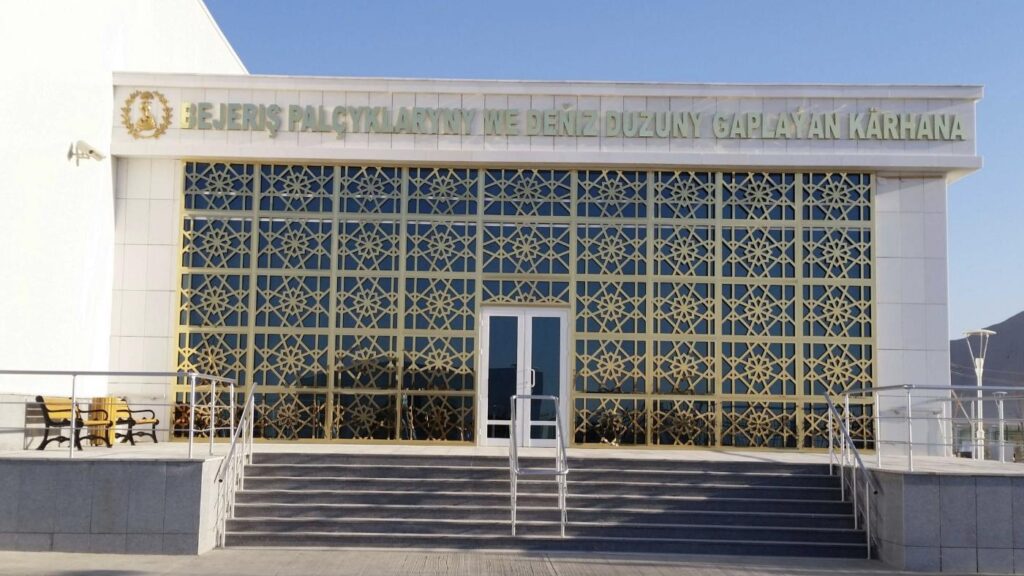
At Jebel, on the road between Balkanabat and the Caspian, a small state plant packs three things that come out of the ground within a few dozen kilometres of it: mud from Lake Mollagara, volcanic mud from the coastal mudflats, and sea salt. It is the only producer of its kind in Turkmenistan, and — unlike almost everything else in this catalogue — it may be one you can contract with directly.
A plant built around one lake
The Factory on Medical Mud and Sea Salt Packing was established in October 2014 at Jebel, in the Balkan region, and sits under the Ministry of Health and Medical Industry rather than under any of the industrial concerns. That placement is the first clue to how it works: it is treated as pharmaceutical production, not as a commodity business.
The plant is small and modern. Italian equipment, two departments — production and quality — and a production system split into four computer-linked sections. Water is treated first: a reverse-osmosis unit prepares 500 litres an hour to the standard the filling lines require.
Two muds, and they are not the same material
Buyers routinely conflate these, and the plant sells both, so it is worth being precise.
Mollagara lake mud
A brine peloid — a sediment matured in place in the lake, saturated with its water rather than mixed with it. The lake runs at 200–250 mg/l mineralisation and carries chlorides and sulfates of sodium, magnesium and iron along with bromine salts; the plant notes that trace silver and gold have been identified in it.
Its selling point, in the producer’s own framing, is physical rather than chemical: Mollagara mud is gravelly, not sandy. It takes up quickly and dries quickly, and they compare it directly with the muds of the Dead Sea and the Saki sanatorium. They describe its use in packs and wraps for the musculoskeletal system, arthritis and polyarthritis, neuritis, osteochondrosis, skin conditions and recovery after injury — joints in particular. See Mollagara therapeutic lake mud.
Volcanic mud
A different material with a different origin. The Turkmen Caspian coast has been forming mudflats and mud lakes for millions of years, and this is what the plant draws on. The distinguishing feature is trace-element content: the producer states the volcanic muds carry rare earths — caesium, beryllium, thallium, germanium and indium among them — and that the material is free of macro- and micro-faunal impurities. See Mollagara volcanic mud.
One thing to clear up, because our own catalogue got it wrong until recently: this is mud, not clay. Clay is defined by mineralogy and particle size and is milled dry then rehydrated. A therapeutic mud is a wet sediment matured in place, carrying dissolved salts and organic matter. Both fall under the term peloid in treatment use, which is why the words get swapped in cosmetics marketing — but if you are buying Mollagara for its brine chemistry, calling it clay is selling it short.
The salt line
Sea salt is crushed, cleaned of impurities including magnetically, then graded to particle size and enriched in a reactor with Turkmen medicinal herbs and natural aromatics. Only natural additives are used. The salt is then filled, and containers are wrapped in aluminium foil to preserve the properties.
Sizes run from 15 to 500 g, with 15, 25 and 160 g as the standard retail packs; the 25 g pack is also supplied for adding to preparations made from medicinal plants. Variants are built on the same salt base with different herbal and aromatic additions. See therapeutic bath salt, and separately the body scrub salt, which is an exfoliant rather than a soak and carries a one-year shelf life against the mud’s five.
Quality control
For a plant this size the laboratory is the part worth knowing about, because it is what a European or Gulf buyer will ask about first. The quality department runs chemical and microbiological testing on both raw material and finished product, on European-type instruments: pH meter, viscometer, densitometer, weighing and high-precision analytical balances, and an electron microscope. Acidity, moisture and flow properties are checked on every batch.
How you would actually buy it
Here is where this producer differs from the rest of the catalogue, and where we would rather be careful than confident.
Almost everything else we write about is made by a state-owned enterprise obliged to sell through the State Commodity and Raw Materials Exchange — the process set out in our guide to how to buy from Turkmenistan. This plant looks different. It is listed on the national export platform with FCA terms, a stated minimum order of 1,000 pieces, and direct contact details for its management — and across four years of exchange records we have not found a single lot of therapeutic mud or cosmetic salt.
That points to direct contracting rather than auction, which would make this among the most straightforward things in Turkmenistan to buy. We would not want you to plan around it before we confirm it, though: our exchange records may simply not cover pharmaceutical production. Ask us and we will establish the route before you commit to anything.
Sourcing from the Mollagara plant
The full range sits under the Mollagara mud and salt plant profile — the two muds, the bath salt and scrub salt, bath bombs, and two herbal packs the plant also fills.
Tell us the product, the pack size and the quantity, and we will come back with what the plant is currently filling, whether your size is in the standard range or needs a run, what the private-label and own-branding options look like, and — the important one here — whether you can contract directly or need to go through the exchange.
Minimum order on the export listing is 1,000 pieces. If you need less than that to test the market, say so; that is a conversation worth having with the plant rather than a closed door.